A key event organized by WARESA Thailand on January 31st at KMUTT University, bringing together students to collaborate, innovate, and support the next generation of African researchers
Held on March 20th at the Seoul Startup Hub, this event celebrated outstanding African researchers, engineers, entrepreneurs, and scientists in Asia, strengthening collaborations within the community.
On April 10–11, 2026, in Taipei, Taiwan, this joint gathering honored the exceptional contributions and inspiring journeys of African scientists, engineers, and entrepreneurs across Asia.
Held on May 22–23, 2026, at Hiroshima University, Japan, this event focused on unlocking the power of community building while celebrating the outstanding achievements of African researchers, engineers, and scientists in Asia.
Explore our latest blog posts, official announcements, and event posters.
A look back at the 2nd WARESA Asia Awards & 7th MIREC in photos!
Dive into the highlights of our joint event held in Taipei, Taiwan. Through this gallery, discover the energy, smiles, and pride that defined these amazing days. These pictures capture not only the award ceremonies but also the power of connection, networking, and collaboration among outstanding African researchers, engineers, and entrepreneurs in Asia. A huge thank you to everyone for making these memories so special!
Empowering researchers, engineers, entrepreneurs, and scientists from Africa and of African heritage IN ASIA
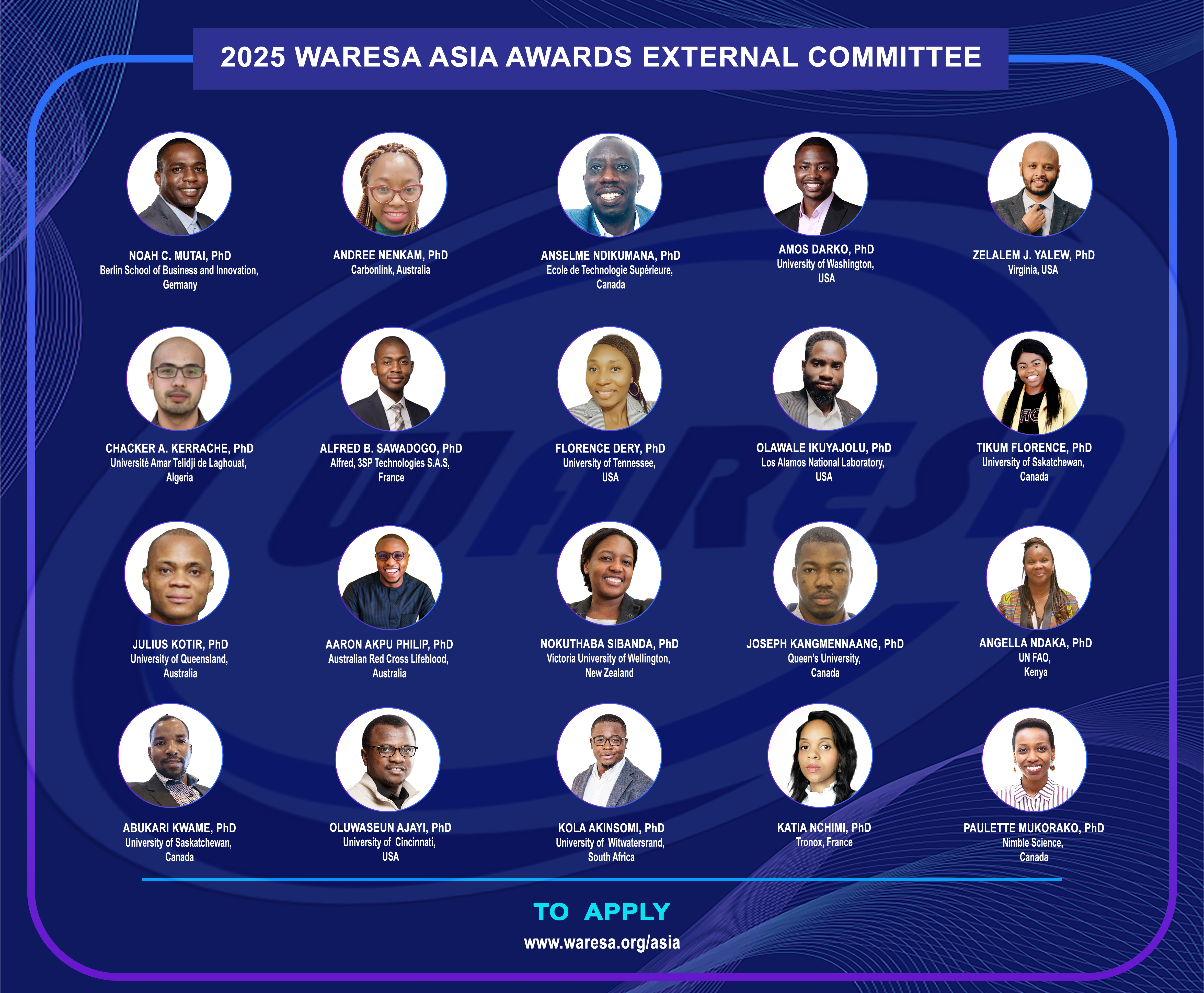
EXTERNAL COMMITTEE
Waresa Asia Awards 2025
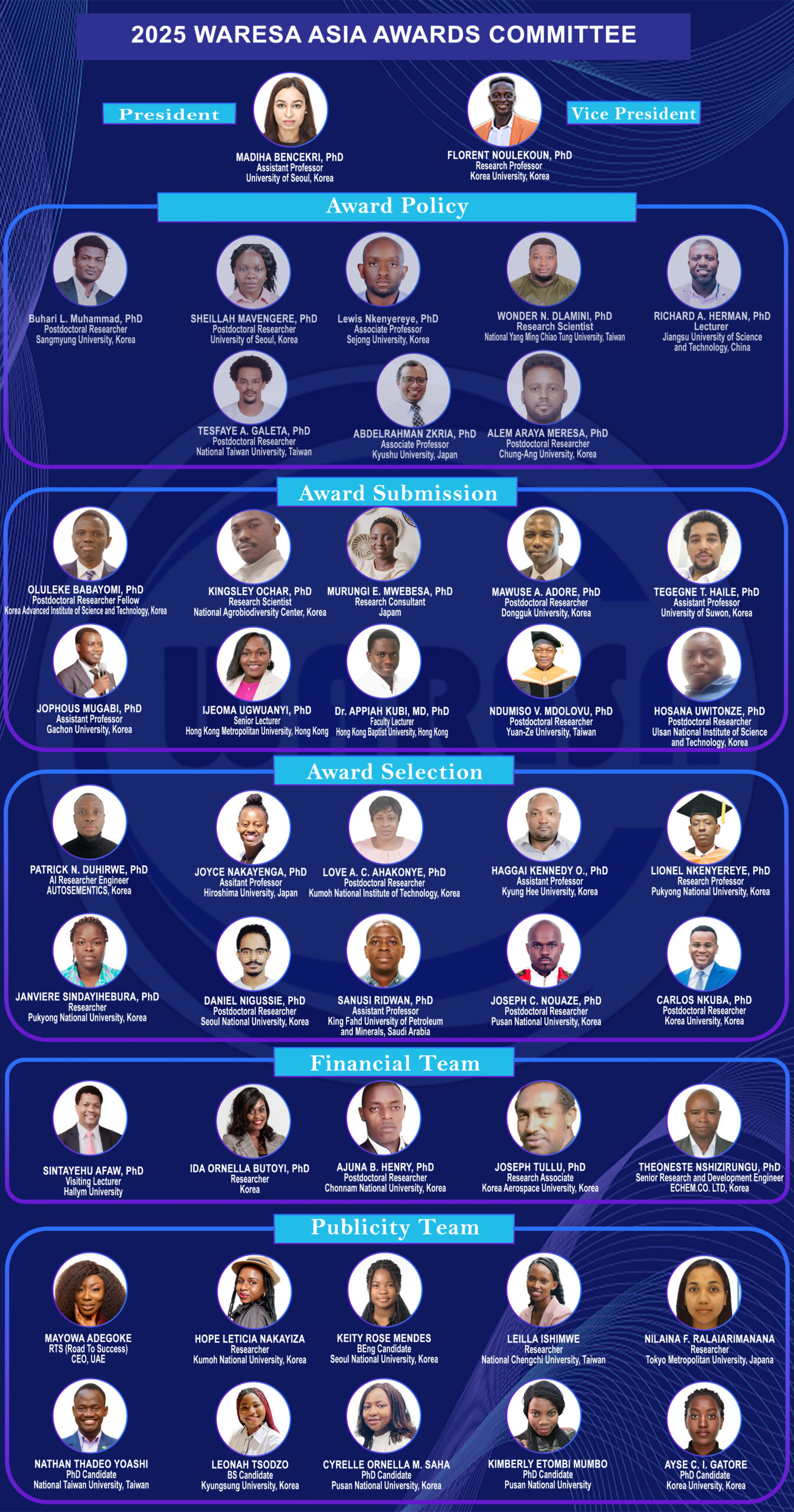
COMMITTEE
Waresa Asia Award 2025
Category A: Best Undergraduate Student Award
Criteria (for A-1 to A-6):
Academic Excellence (20%) – High GPA or equivalent academic performance.
Research & Innovation (40%) – Participation in research publications, projects, or innovative initiatives.
Leadership & Community Impact (20%) – Active involvement in student leadership, community service, or extracurricular activities.
Endorsements (10%) – Recommendation letters from faculty, mentors, or community leaders.
Personal Statement (10%) – A statement highlighting achievements, future aspirations, and contributions to African development.
Category B: Best Master’s Students Award
Criteria (for B-1 to B-6):
Academic Excellence (20%) – High GPA or equivalent academic performance.
Research & Innovation (40%) – Contribution to research publications, projects, or innovative initiatives.
Leadership & Community Impact (20%) – Active engagement in student leadership, community service, or extracurricular activities.
Endorsements (10%) – Recommendation letters from faculty, mentors, or community leaders.
Personal Statement (10%) – A statement outlining achievements, future aspirations, and contributions to African development.
Category C: Best Research Paper for PhD Students Award (For doctorate students only)
Criteria (for C-1 to C-6):
Publication & Recognition (100%) – Indexed in Web of Science, with journal ranking evaluated based on topic. Q1 is occupied by the top 25% of journals in the list; Q2 is occupied by journals in the 25 to 50% group; Q3 is occupied by journals in the 50 to 75% group and Q4 is occupied by journals in the 75 to 100% group. The most prestigious journals within a subject area are those which occupy the first quartile, Q1. Even within Q1 (25%), some journals occupied 5%. 10% or 15 %.
Category D: Highest Field Ranking Paper Award (For Postdocs, faculty and others)
Criteria (for D-1 to D-6):
Publication & Recognition (100%) – Indexed in Web of Science, with journal ranking evaluated based on topic. Q1 is occupied by the top 25% of journals in the list; Q2 is occupied by journals in the 25 to 50% group; Q3 is occupied by journals in the 50 to 75% group and Q4 is occupied by journals in the 75 to 100% group. The most prestigious journals within a subject area are those which occupy the first quartile, Q1. Even within Q1 (25%), some journals occupied 5%. 10% or 15 %.
Category E: Most Cited Researcher Award
Criteria (for E-1 to E-6):
Total Citation Count (100%) – Based on Google Scholar citations (self-citations should not go beyond 20%).
Category F: Integration Excellence Award
Criteria:
Category F: Integration Excellence Award
Evaluation Criteria:
Language Proficiency (35%) – Demonstrated commitment to learning the local language, measured by the highest level of proficiency achieved (if applicable).
Community Engagement (35%) – Active participation and meaningful integration within local communities.
Local Impact & Recognition (30%) – Implementation of a community-focused project and/or official recognition from the local municipality.
.
Category G: Best African Students Association Award
Criteria (for G-1):
Community Engagement (40%) – Activities fostering networking, mentorship, and collaboration.
Impact & Outreach (30%) – Programs benefiting African students and professionals abroad.
Sustainability (20%) – Long-term vision and consistent impact.
Innovation & Leadership (10%) – Unique initiatives and leadership in organizing activities.
Category H: African Entrepreneurship & Innovation Award
Criteria (for H-1 & H-2):
Innovation & Uniqueness (40%) – Novelty and potential industry disruption.
Business Impact (30%) – Market reach, scalability, and business success.
Social Impact (20%) – Contributions to African communities and economic development.
Recognition & Endorsements (10%) – Awards, media coverage, and industry recognition.
Category I: Outstanding African Professional in Industry Award (Target: Career accomplishments outside academia)
Criteria (for I-1 & I-2):
Professional Achievements (50%) – Career accomplishments after graduation.
Industry Contributions (20%) – Innovations, mentorship, or policy influence.
Impact on Africa (20%) – Contributions to African development.
Peer Recognition (10%) – Endorsements and awards.
Special Recognition Awards
J. Friend of Africans Award (J-1) – 5 Awards
Criteria:
Support for African Students & Professionals (70%) – Contributions to African development.
Cross-Cultural Engagement (10%) – Efforts in fostering collaboration between Africa and other regions.
Sustained Involvement (10%) – Consistent support for African causes.
Endorsements (10%) – Recommendations from African organizations.
K. Best NGO for Africa Award (J-2) – 5 Awards
Criteria:
Impact & Reach (40%) – Effectiveness in improving the lives of Africans in the diaspora and beyond.
Sustainability (30%) – Long-term impact and program success.
Innovation (20%) – Unique approaches to addressing challenges.
Recognition (10%) – Awards and peer acknowledgments.
L. Outstanding Embassy Service Award (J-3) – 10 Awards
Criteria:
Support for African Students & Professionals (40%) – Passport / Visa services, student support, and community engagement.
Public Diplomacy (30%) – Efforts in promoting African interests.
Responsiveness & Accessibility (20%) – Efficiency in service delivery.
Testimonials & Peer Recognition (10%) – Feedback from African communities.
WARESA invites African students (Bs, Ms, and PhD), researchers, engineers, scientists, academicians, entrepreneurs currently living in any Asian country (the list can be found here), to submit applications for Awards competition. The main objective of these awards is to recognize and reward excellence in research for both STEM, Social Sciences fields and humanities fields. The awards celebrates also the non-African who contributed to their success
We have 60 awards for 10 categories (A-J)
[Mix is for mixed category for both male and female and F.O stands for Female Only category]
1 (A-1) Best Undergraduate Student Award /STEM-Mix 2 (A-2) Best Undergraduate Student Award /Social Science-Mix 3 (A-3) Best Undergraduate Student Award /Humanities-Mix 4 (A-4) Best Undergraduate Student Award /STEM-F.O 5 (A-5) Best Undergraduate Student Award /Social Science-F.O 6 (A-6) Best Undergraduate Student Award /Humanities-F.O 7 (B-1) Best Research Paper for Ms Students Award /STEM-Mix 8 (B-2) Best Research Paper for Ms Students Award/Social Science-Mix 9 (B-3) Best Research Paper for Ms Students Award/Humanities-Mix 10 (B-4) Best Research Paper for Ms Students Award /STEM-F.O 11 (B-5) Best Research Paper for Ms Students Award/Social Science-F.O 12 (B-6) Best Research Paper for Ms Students Award/Humanities-F.O 13 (C-1) Best Research Paper for PhD Students Award /STEM-Mix 14 (C-2) Best Research Paper for PhD Students Award/Social Science-Mix 15 (C-3) Best Research Paper for PhD Students Award/Humanities-Mix 16 (C-4) Best Research Paper for PhD Students Award /STEM-F.O 17 (C-5) Best Research Paper for PhD Students Award/Social Science-F.O 18 (C-6) Best Research Paper for PhD Students Award/Humanities-F.O 19 (D-1) Highest Field Ranking Paper Award /STEM-Mix 20 (D-2) Highest Field Ranking Paper Award/Social Sience-Mix 21 (D-3) Highest Field Ranking Paper Award/Humanities-Mix 22 (D-4) Highest Field Ranking Paper Award /STEM-F.O 23 (D-5) Highest Field Ranking Paper Award/Social Sience-F.O 24 (D-6) Highest Field Ranking Paper Award/Humanities-F.O 25 (E-1) Most Cited Researcher Award /STEM-Mix 26 (E-2) Most Cited Researcher Award /Social Science-Mix 27 (E-3) Most Cited Researcher Award /Humanities-Mix 28 (E-4) Most Cited Researcher Award /STEM-F.O 29 (E-5) Most Cited Researcher Award /Social Science-F.O 30 (E-6) Most Cited Researcher Award /Humanities-F.O 31 (F-1) Local Language Proficiency Awards /self-sponsored-Mix 32 (F-2) Local Language Proficiency Awards /self-sponsored-F.O 33 (F-3) Local Language Proficiency Awards /sponsored-Mix 34 (F-4) Local Language Proficiency Awards /sponsored-F.O 35 (G-1) Best African Students Community Award 36 (G-2) Second Best African Students Association Award 37 (H-1) African Entrepreneur in Asia Award-Mix 38 (H-2) African Entrepreneur in Asia Award-F.O 39 (I-1) Outstanding African Professional in Industry Award-Mix
40 (I-2) Outstanding African Professional in Industryl Award-F.O 41 (J-1) Friend of African Award (5 awards )
42 (J-2) Best NGO for Africa Award (5 awards )
43 (J-3) Outstanding Embassy Service Award (10 awards )
Applications open date: 15 December 2024
Application close date: 28 February 2025
Venue: Seoul Startup Hub 21, Baekbeom-ro 31-gil, Mapo-gu, Seoul
Award Day: Sat, 8th March 2025
For any questions or inquires, send us an email at awards@waresa.org or info@waresa.org
To apply or nominate someone, please fill the below form