



Join Us
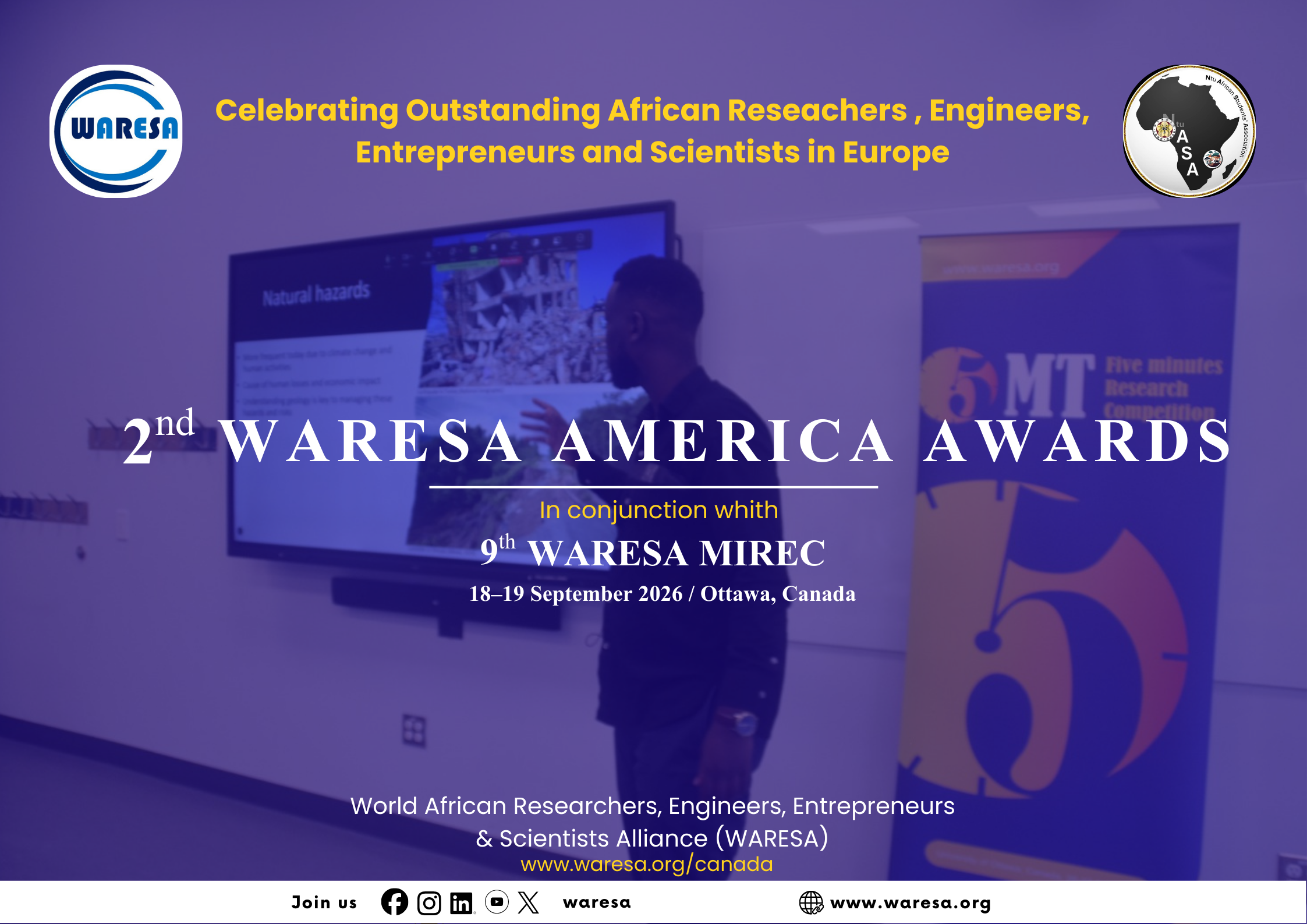
for the 2nd Waresa America Awards & 9th Waresa MIREC! Come celebrate the outstanding achievements of African researchers, engineers, entrepreneurs, and scientists in the Americas ( South, Central and North America) . Connect with global innovators on September 18–19, 2026, in Calgary, Canada.Be part of the future of science and leadership!
Celebrating African
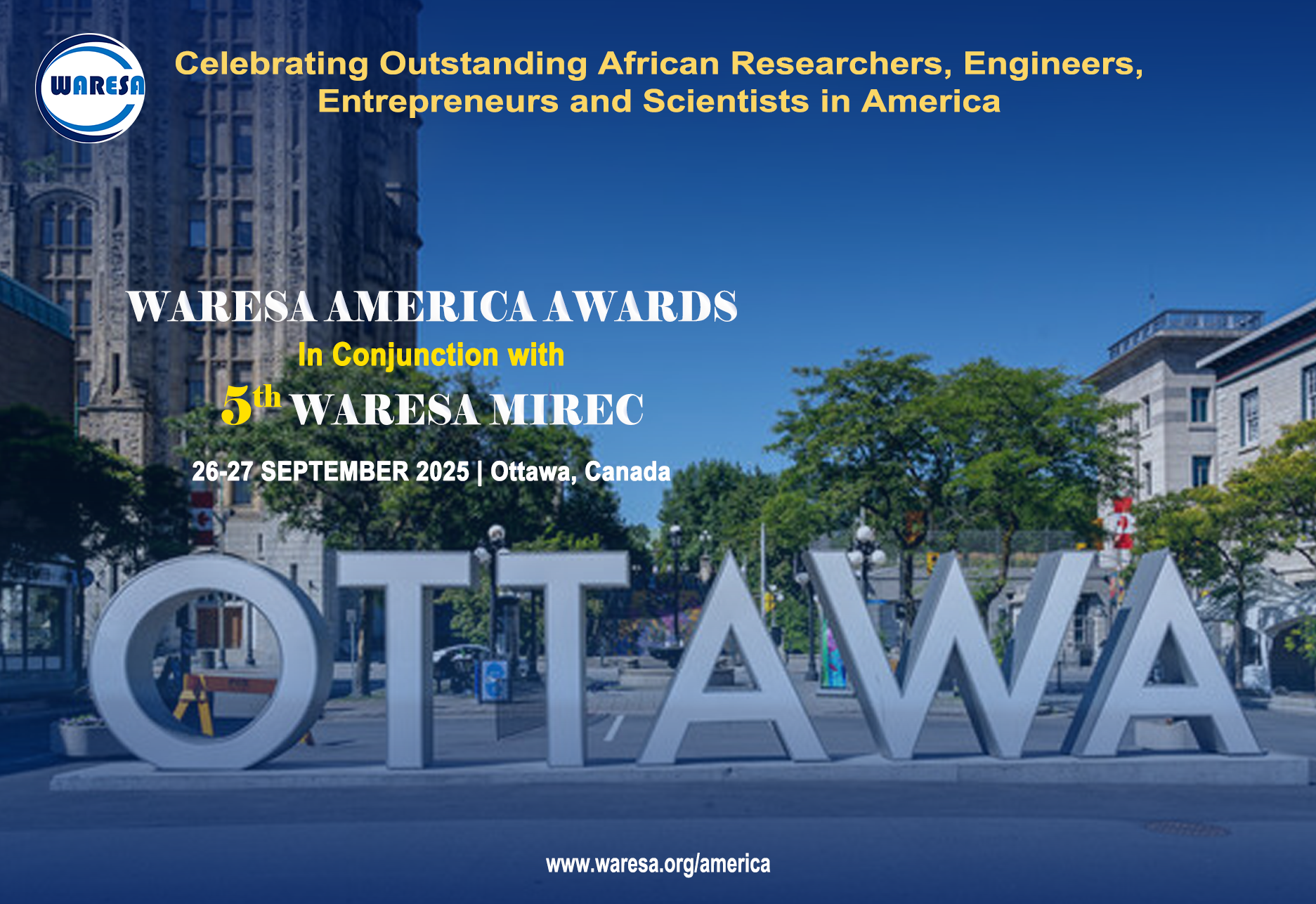
Excellence in America! Join us on September 26–27, 2025, in Ottawa, Canada, as we honor outstanding African researchers, engineers, entrepreneurs, and scientists. A premier gathering driving innovation, science, and leadership.
Looking Back at the MIREC 2025 Conference in Ottawa
Discover the highlights of the 5th Multidisciplinary International Research Conference, a major hybrid event organized by WARESA (World African Researchers, Engineers, Entrepreneurs & Scientists Alliance). Hosted at the University of Ottawa in Canada, the conference brought together researchers, academics, and professionals to share their work across key tracks, including STEM, humanities, management, and biopharmaceutical research. Relive this great moment of scientific exchange and innovation through our event photos!

WhatsApp Image 2026-07-07 at 7.00.33 AM

WhatsApp Image 2026-07-07 at 7.00.32 AM (1)

WhatsApp Image 2026-07-07 at 7.00.32 AM
WARESA America Awards 2025 Award Categories & Selection Criteria
WARESA invites African students (and those of African descent), including BS, MS, and PhD students, researchers, engineers, scientists, academicians, and entrepreneurs, currently living in South, Central, or North America to submit applications for the Awards Competition.
The main objective of these awards is to recognize and reward excellence in research across STEM, Social Sciences, and Humanities fields. The awards also celebrate non-Africans who have contributed to the success of Africans in these areas.
We have 60 awards for 13 categories (A-M)
[Mix is for mixed category for both male and female and F.O stands for Female Only category]
Category A – Best Undergraduate Student Awards
- 1 (A-1) Best Undergraduate Student Award /STEM-Mix
- 2 (A-2) Best Undergraduate Student Award /Social Science-Mix
- 3 (A-3) Best Undergraduate Student Award /Humanities-Mix
- 4 (A-4) Best Undergraduate Student Award /STEM-F.O
- 5 (A-5) Best Undergraduate Student Award /Social Science-F.O
- 6 (A-6) Best Undergraduate Student Award /Humanities-F.O
Eligibility: Undergraduate students (A-1 to A-6)
Evaluation Criteria:
- Academic Excellence (40%) – Outstanding academic performance, demonstrated by GPA or equivalent metrics.
- Research & Innovation (20%) – Participation in research projects, academic publications, or innovative initiatives.
- Leadership & Community Engagement (15%) – Active involvement in student leadership, extracurricular activities, or community service.
- Endorsements (10%) – Strong letters of recommendation from faculty, mentors, or community leaders.
Personal Statement (15%) – A reflective essay highlighting achievements, future goals, and commitment to African development.
Category B – Best Master’s Student Awards
- 7(B-1) Best Master’s Student Award /STEM-Mix
- 8 (B-2) Best Master’s Student Award/Social Science-Mix
- 9 (B-3) Best Master’s Student Award/Humanities-Mix
- 10 (B-4) Best Master’s Student Award /STEM-F.O
- 11 (B-5) Best Master’s Student Award/Social Science-F.O
- 12 (B-6) Best Master’s Student Award/Humanities-F.O
Eligibility: Master’s students (B-1 to B-6)
Evaluation Criteria:
- Academic Excellence (20%) – Demonstrated academic success through GPA or equivalent indicators.
- Research & Innovation (40%) – Significant contributions to research, publications, or innovation.
- Leadership & Community Engagement (15%) – Active involvement in leadership roles and community service.
- Endorsements (10%) – Recommendations from academic or community leaders.
- Personal Statement (15%) – A narrative outlining academic journey, aspirations, and contributions to African development.
Category C – Best PhD Student Awards
Eligibility: Doctoral students (C-1 to C-6)
Evaluation Criteria for STEM Fields:
- Research Excellence (90%) – Peer-reviewed publications indexed in Web of Science, evaluated by journal quartiles (Q1–Q4), with additional merit for top-tier subpercentiles (e.g., top 5%, 10%, 15%).
- Personal Statement (10%) – A clear articulation of how the research addresses critical African challenges.
Evaluation Criteria for Social Sciences & Humanities:
- Research Excellence (70%) – Peer-reviewed publications indexed in Web of Science, evaluated by journal quartiles (Q1–Q4), with additional merit for top-tier subpercentiles (e.g., top 5%, 10%, 15%).
- Research Impact (20%)– Evaluation based on readership/download metrics, the influence of conference presentations, and quality of media-based outputs (e.g., documentaries, videos).
- Personal Statement (10%)– Emphasis on the real-world application of research in African social, political, or cultural contexts.
Category D – Highest Field-Ranking Research Awards
- 19 (D-1) Highest Field-Ranking Research Award /STEM-Mix
- 20 (D-2) Highest Field-Ranking Research Award/Social Sience-Mix
- 21 (D-3) Highest Field-Ranking Research Award/Humanities-Mix
- 22 (D-4) Highest Field-Ranking Research Award /STEM-F.O
- 23 (D-5) Highest Field-Ranking Research Award/Social Sience-F.O
- 24 (D-6) Highest Field-Ranking Research Award/Humanities-F.O
Eligibility: Doctoral and postdoctoral researchers, faculty members, and professionals (D-1 to D-6)
Evaluation Criteria:
- Research Achievement (90%) –
STEM Fields: Web of Science-indexed publications, ranked by journal quartiles (Q1–Q4).
Social Sciences & Humanities: Conference papers, readership/download data, and public/media-based outputs (e.g., documentaries, videos).
- Personal Statement (10%) – Insights into how the research addresses key African challenges.
Category E – Research Impact Awards
Eligibility: Postdoctoral researchers, faculty members, and industry-based researchers (E-1 to E-6)
Evaluation Criteria:
STEM Fields:
- Citation Impact (70%) – Total Google Scholar citations (self-citations capped at 20%).
- Engagement (30%) – Number of downloads or reads of research articles.
Social Sciences & Humanities:
- Citation Impact (70%) – Total Google Scholar citations (self-citations capped at 20%).
- Engagement (30%) – Number of downloads or reads of research articles, public/media-based outputs.
Category F: African Academic Gateway Award (self-nomination is not allowed)
Eligibility: exceptional African student, scholar, or professional living in north, central or south America who has significantly contributed to expanding academic access for fellow Africans through mentorship, advocacy, and institutional engagement.
Evaluation Criteria:
- Mentorship for African Students (40%) – Demonstrated, sustained commitment to mentoring African students
- Advocacy for African Students (30 %)- Proactive promotion of educational opportunities abroad for African students
- Institutional or University Linkages (30%) : Active role in building or strengthening pathways between African students and international universities
Category G – Integration Excellence Award
Eligibility: International students and professionals who have actively integrated into their host communities
Evaluation Criteria:
- Language Adaptability (35%) – Level of proficiency and commitment to learning and using the host country’s language.
- Community Engagement (35%) – Participation in local civic, cultural, or social activities.
- Local Impact & Recognition (30%) – Execution of community-based projects and/or formal recognition by local authorities.
Category H – Best African Students Community Award
Eligibility: Registered African student associations
Evaluation Criteria:
- Community Engagement (40%) – Initiatives fostering mentorship, networking, and collaboration.
- Impact & Outreach (30%) – Programs that benefit African students and professionals.
- Sustainability (20%) – Evidence of long-term vision and consistency in execution.
- Innovation & Leadership (10%) – Creative approaches and effective organizational leadership.
Category I – African Entrepreneurship & Innovation Awards
Eligibility: African entrepreneurs and innovators
Evaluation Criteria:
- Innovation & Originality (40%) – Novel solutions with potential for industry disruption.
- Business Impact (30%) – Demonstrated scalability, market reach, and success.
- Social Contribution (20%) – Tangible contributions to African communities or economies.
- Recognition & Endorsements (10%) – Awards, media coverage, or institutional validation.
Category J – African Industry Professional Awards
Eligibility: Professionals with significant career accomplishments outside academia
Evaluation Criteria:
- Professional Excellence (50%) – Major career achievements post-graduation.
- Industry Contributions (20%) – Innovations, mentorship, or influence on industry practices or policy.
- Impact on Africa (20%) – Contributions to African development and progress.
- Peer Recognition (10%) – Awards or commendations from industry peers or professional bodies.
Special Recognition Awards
Category K – Friend of Africa Award
Eligibility: Non-African individuals (5 awards)
Evaluation Criteria:
- Support for African Advancement (70%) – Meaningful contributions to African development, students, or professionals.
- Cross-Cultural Collaboration (10%) – Engagement in partnerships between Africa and other regions.
- Long-Term Commitment (10%) – Sustained support of African-centered initiatives.
- Endorsements (10%) – Recommendations from African organizations or leaders.
Category L – Best NGO for Africa Award
Eligibility: NGOs that improve lives in Africa and the diaspora (5 awards)
Evaluation Criteria:
- Impact & Reach (40%) – Proven effectiveness and broad influence.
- Sustainability (30%) – Demonstrated long-term program success and organizational stability.
- Innovation (20%) – Unique and creative approaches to solving challenges.
- Recognition (10%) – Awards or acknowledgment by peers and institutions.
Category M – Outstanding Embassy Service Award
Eligibility: Embassies providing exceptional service to African nationals abroad (5 awards)
Evaluation Criteria:
- Support Services (40%) – Quality of services related to passports, visas, and student support.
- Public Diplomacy (30%) – Advocacy for African interests and cultural promotion.
- Responsiveness & Accessibility (20%) – Efficiency and ease of access to services.
- Community Testimonials (10%) – Positive feedback from African communities served.
Applications open date: 15 June 2026
Application close date: 15 September 2026
Venue: University of Ottawa, Canada
Award Day: 18-19th September 2026
For any questions or inquires, send us an email at americaawards@waresa.org or info@waresa.org
To apply or nominate someone, please fill the below form